
The Lagos State Government has presented a detailed one-year performance report on basic and senior secondary education, highlighting significant progress recorded under the Education and Technology pillar of Governor Babajide Sanwo-Olu’s T.H.E.M.E.S+ development agenda.
The scorecard revealed notable achievements in classroom expansion, digital learning, teacher development, student welfare, and academic performance across public schools in the state.
The Ministry of Basic and Secondary Education unveiled the report during a ministerial press briefing held in Ikeja as part of activities marking the third year of Governor Sanwo-Olu’s second-term administration.
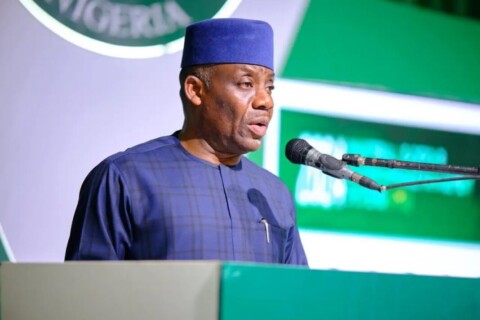
Speaking at the briefing, the Commissioner for Basic and Secondary Education, Jamiu Alli-Balogun, said the reforms are focused on ensuring that every child in Lagos has access to quality and inclusive education regardless of background.
According to him, the government’s investments in digital learning, teacher training, infrastructure, and student support initiatives are reshaping the public education sector and preparing students for success in a technology-driven global environment.
“Our investments in digital learning systems, teacher development, school infrastructure, and student support are transforming public education across Lagos State,” he stated. “We are creating equal opportunities for all learners to access quality education and acquire globally relevant skills.”
The commissioner disclosed that the interventions have already produced measurable improvements in students’ academic performance, with public school students recording a 61.52 per cent pass rate in the 2025 West African Senior School Certificate Examination (WASSCE).
To further support students and reduce the financial burden on families, the state introduced the Eko Learners Support Initiative. Under the programme, the government fully paid the 2026 WASSCE registration fees for 45,598 Senior Secondary School III students.
The ministry also distributed millions of curriculum-based textbooks, digital learning tools, and instructional materials across schools in the six education districts.
On infrastructure development, Alli-Balogun revealed that the government established 15 new public schools in underserved communities between 2025 and 2026.
He added that 47 schools were fully rehabilitated in 2025 alone, bringing the total number of upgraded public schools in Lagos to 433.
As part of efforts to improve learning conditions, the government delivered 1,416 modern classrooms and supplied 223,343 furniture units to public schools to tackle overcrowding and improve comfort for learners.
The commissioner highlighted the renovation of the Tolu School Complex in Ajegunle as one of the administration’s landmark projects, describing it as a transformation into a modern educational hub.
He noted that the state’s school expansion and rehabilitation projects reflect the government’s commitment to creating safe, accessible, and modern learning environments while also helping to reduce the number of out-of-school children.
Recognising teachers as key drivers of educational progress, the state also strengthened teacher recruitment and professional development.
According to Alli-Balogun, the ministry recruited 2,768 teachers to improve classroom learning and student-teacher ratios in public schools.
In addition, 9,456 teachers benefited from specialised training programmes and welfare initiatives aimed at improving teaching quality and professional capacity.
He explained that the Teachers Digital Hub has played a major role in expanding teachers’ access to online learning resources, digital teaching tools, and innovative instructional methods.
The commissioner also disclosed that technical and vocational education experienced significant growth, with student enrollment in technical colleges surpassing 10,000 annually.
He stated that entrepreneurship and industry-related skills programmes have now been integrated into the curriculum to improve employability and self-reliance among students.
On innovation and technology, Alli-Balogun said Lagos students excelled internationally after the state’s robotics teams secured first and third positions in Africa at the World Robotics Olympiad.
According to him, the achievement reflects the success of the government’s efforts to expand coding and Artificial Intelligence (AI) clubs in public schools.
Looking ahead, the ministry said it remains committed to sustaining educational reforms through its long-term development strategy.
The commissioner explained that future plans include expanding the Eko Learners Support Initiative, strengthening STEAM and Innovate-Eko programmes, improving Technical and Vocational Education and Training (TVET), recruiting more STEM and vocational teachers, and increasing financial support through the proposed Lagos Education Access Fund (LEAF).
Alli-Balogun also expressed appreciation to Governor Sanwo-Olu for supporting the ministry’s programmes and reforms throughout the past year.