

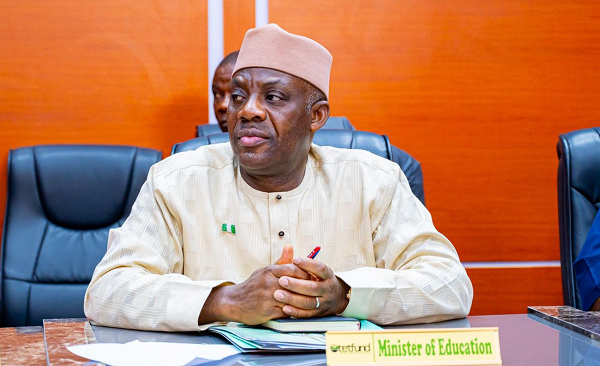
Minister of Education, Dr. Olatunji Alausa, has disclosed that nearly 80 per cent of donor funding allocated to Nigeria’s education sector over the past decade was concentrated in the North-West and North-East regions.
Despite receiving the bulk of international support, the minister noted that both regions continue to record the poorest literacy and numeracy levels in the country. He said the Federal Government now has access to more reliable education data that will help improve how resources are distributed for better outcomes.
Alausa made this known on Monday during a special roundtable session at the Education World Forum (EWF) held in London, United Kingdom. According to a statement released by his Special Adviser on Media and Communications, Ikharo Attah, the minister engaged global education stakeholders and fellow ministers on Nigeria’s ongoing reforms in foundational learning.
Speaking during the session, Alausa explained that findings from the National Education Data Initiative (NEDI) exposed major concerns about the effectiveness of donor interventions in some parts of the country.
According to him, although most donor funds were directed to the North-West and North-East over the years, literacy and numeracy outcomes in the regions remain significantly low. He added that the availability of credible data would now enable government and development partners to channel investments into programmes that produce measurable impact.
The minister also highlighted Nigeria’s efforts to strengthen foundational literacy and numeracy through a unified national system that integrates both formal and non-formal education structures.
He explained that the government is currently expanding the Reach All Nigerians through Education (RANA) programme for pupils in Primary 1 to 3, alongside the Teaching at the Right Level initiative for Primary 4 to 6 pupils across 15 states through the Universal Basic Education Commission (UBEC). The programmes rely on structured lesson plans, regular teacher mentoring, and continuous assessments to improve learning outcomes.
Alausa further stated that the Accelerated Basic Education Programme (ABEP), developed by the Nigerian Educational Research and Development Council (NERDC), is helping out-of-school children and adolescents achieve foundational literacy and numeracy within a three-year learning period.
He noted that both formal and non-formal education systems are now integrated into the NEDI platform, allowing government authorities to monitor educational coverage and learning progress through a single dashboard for the first time.
The minister pointed to several successful state-led education reforms already delivering measurable results across the country. He cited initiatives such as EKOEXCEL, KwaraLEARN, and BayelsaPRIME as examples of technology-driven teaching models improving learning standards.
According to him, KwaraLEARN succeeded in reducing foundational learning deficiencies by half within two years, while BayelsaPRIME recorded a 20 percentage-point increase in literacy levels within just 19 weeks.
On policy reforms, Alausa said foundational literacy and numeracy remain central to President Bola Tinubu’s Renewed Hope Agenda and the National Foundational Literacy and Numeracy Programme.
He revealed that the Federal Government is currently finalising a National Policy on Foundational Literacy and Numeracy, aimed at establishing a long-term legal and institutional framework to support reforms across federal, state, and non-formal education systems.
The minister also disclosed that under Nigeria’s Partnership Compact with the Global Partnership for Education (GPE), about 70 per cent of education funding is now tied directly to measurable outcomes in learning performance, teacher management, and effective use of education data.
In addition, he announced plans by the Federal Government to increase the Universal Basic Education Commission’s share of the Consolidated Revenue Fund from two per cent to four per cent, a move expected to significantly boost funding for basic education nationwide.
Addressing the issue of out-of-school children, Alausa said the Accelerated Basic Education Programme now provides a recognised pathway for children outside the formal school system to transition into Junior Secondary School.
He explained that both ABEP centres and conventional schools currently use the same teaching materials, coaching systems, and supervision methods across 15 states, ensuring uniform standards and reducing duplication of resources.
The minister maintained that Nigeria’s education reforms are now shifting focus away from mere funding and infrastructure toward measurable learning outcomes. He expressed confidence that the ongoing reforms and improved data systems would help the country tackle learning poverty more effectively and sustainably.