

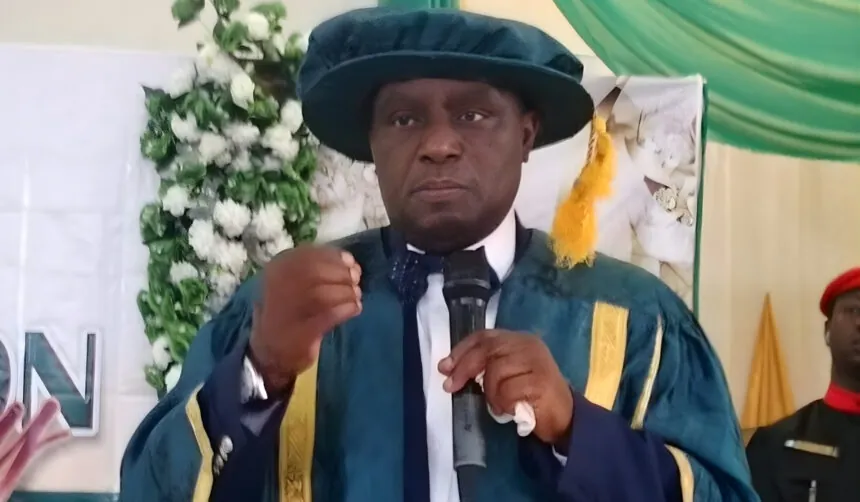
Former Executive Secretary of the National Universities Commission (NUC), Emeritus Professor Peter Okebukola, has expressed concern over the low level of investment in research and development (R&D) in Nigerian universities.
Delivering the convocation lecture titled “Universities in the Age of Quantum Thinking: Redefining Quality, Relevance and Innovation through Emerging Technologies” at the 13th convocation ceremony of Kwara State University (KWASU) on Thursday, Professor Okebukola revealed that Nigeria currently allocates only 0.2 per cent of its GDP to research, well below the African average of 0.5 per cent and far behind global leaders investing 3 to 4 per cent. He urged a significant increase in R&D funding for both federal and state universities.
He recommended that the government introduce tax incentives for private sector organisations that fund university research or establish research chairs in emerging technology fields. He also called for expanding international partnerships, citing the NUC’s 2025 collaboration with France’s AFD on a €38 million ICT transformation project, to bring both funding and expertise to Nigerian universities.
Professor Okebukola further suggested that government-mandated capacity-building components in technology procurement contracts could ensure the development of local expertise, reducing dependence on foreign knowledge. He also highlighted the need to tackle brain drain by creating competitive research fellowship programs that attract Nigeria’s top talent back into the country, particularly in emerging technology areas.
On the lecture topic, Professor Okebukola explained that quantum thinking involves multi-dimensional problem-solving. He said traditional universities operate on Newtonian principles, with knowledge compartmentalized and outcomes predictable, but modern challenges—such as climate change, AI ethics, pandemic preparedness, and sustainable development—require a quantum approach, combining expertise across disciplines to generate solutions in an era of uncertainty.
“Quantum thinking is not merely metaphorical,” he said. “It is a necessary cognitive framework for institutions in an era where nearly one billion jobs worldwide will undergo major technological changes in the next decade. Universities must cultivate cognitive agility in students and staff, moving beyond single-answer thinking to embrace the productive uncertainty of today’s complex world.”
In his welcome address, KWASU Vice Chancellor Professor Shaykh-Luqman Jimoh emphasised the university’s commitment to transformative ideas and innovations that contribute to societal development. He noted that KWASU encourages collaborations that connect academic expertise with practical, mutually beneficial community engagement.
Professor Jimoh added, “A convocation ceremony celebrates academic excellence, but it is also an avenue for distinguished speakers to share insights on national issues, inspiring graduates while provoking discussions that can influence policy and practice in Nigeria.”