

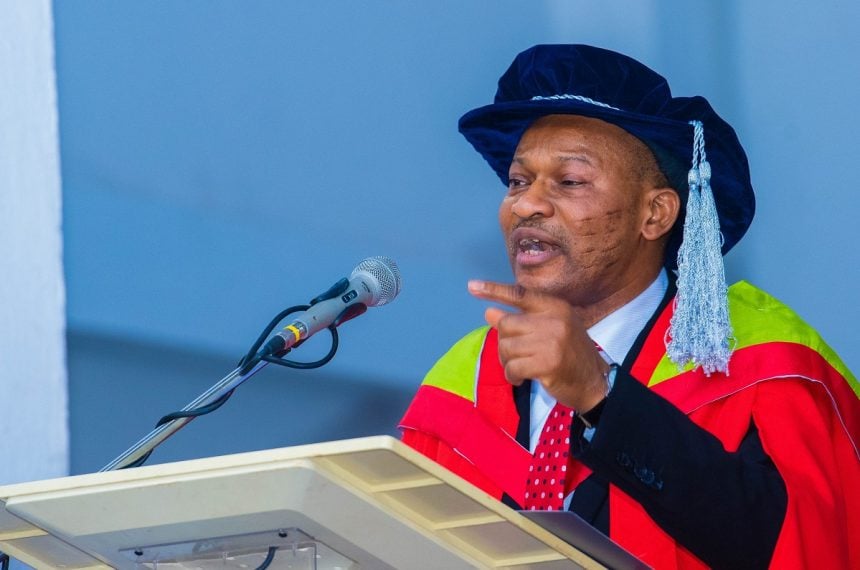
The immediate past Registrar and Chief Executive of the Teachers’ Registration Council of Nigeria (TRCN), Professor Josiah Ajiboye, has urged Nigeria to fundamentally rethink its approach to education financing in order to address the deep-rooted challenges facing the sector and place it on a path of sustainable development.
Ajiboye made the call during an interaction with members of the Education Correspondents Association of Nigeria (ECAN) in Abuja. The former TRCN registrar, who was recently elected Vice President I of the Nigerian Academy of Education (NAE), stressed that governments at all levels must begin to see funds allocated to education as an investment rather than mere expenditure.
He expressed serious concern over what he described as Nigeria’s growing “learning poverty” crisis. Citing global data from the United Nations Children’s Fund (UNICEF), Ajiboye noted that more than 75 per cent of Nigerian children aged 7 to 14 are unable to read a simple text, while about 45 million children are classified as learning poor and cannot read age-appropriate materials.
Despite relatively high school enrolment figures, Nigeria is ranked second globally in the number of out-of-school children, estimated at about 17 million. Ajiboye observed that this reflects a disturbing gap between school attendance and actual learning, particularly in the northern parts of the country.
“Learning poverty is real. Several international and local statistics confirm it, and we cannot deny what is obvious,” he said.
According to him, the crisis is driven by multiple factors, including poor school infrastructure, inadequate teacher preparation, insecurity, weak supervision, shortage of teaching resources, and inconsistent policy implementation. However, he identified chronic underinvestment in education as the most significant contributor.
Ajiboye acknowledged that funding alone cannot solve all education problems but insisted that it plays a decisive role in shaping outcomes. He argued that a shift in mindset is urgently needed.
“As a country, we need to rethink our philosophy of education financing. We should stop seeing education spending as mere expenditure. It is an investment that may not yield immediate financial returns but transforms society over time,” he said.
He added that when political leaders view education as a long-term investment, they are more likely to commit the necessary resources required to improve learning outcomes and deliver quality education to Nigerian children.
Reflecting on his eight-year tenure as TRCN registrar, Ajiboye highlighted several reforms introduced to strengthen professionalism in teaching. Chief among them was the establishment of the Professional Qualifying Examination (PQE), which he described as a critical gatekeeping mechanism for the teaching profession.
“Before our reforms, there was no effective gatekeeping. Today, no one can be certified as a professional teacher without passing the PQE. Teaching, like other professions, must operate with clear standards,” he said.
He also noted that the council reviewed and produced an updated Professional Standards for Nigerian Teachers to guide competence and ethical conduct. In addition, the TRCN developed, for the first time, Professional Standards for School Leadership and introduced a structured career path for teachers nationwide.
Ajiboye further spoke on the recently enacted dual mandate for Colleges of Education, which allows them to award both NCE and degree qualifications. He cautioned that the policy must be properly implemented to avoid distortions and to strengthen teacher preparation.
He emphasised that Nigeria still needs well-trained NCE and diploma-level teachers, especially for basic education, which he described as the foundation of the entire education system.
“If effectively implemented, the dual mandate will help produce well-prepared teachers for foundational learning. Basic education is the bedrock of the system, and the quality of teachers at that level determines everything else,” he said.