

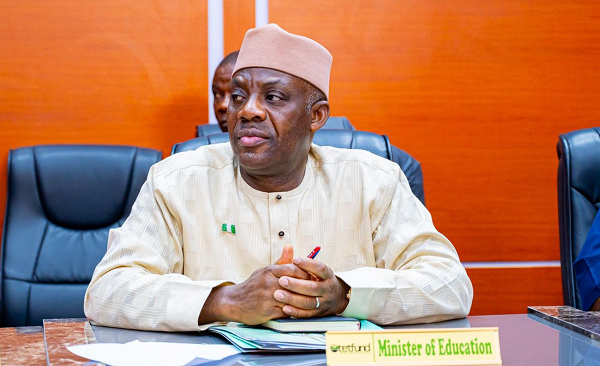
The Federal Government has stepped up measures to safeguard schools nationwide by reinforcing the Safe Schools Initiative in collaboration with the Nigeria Security and Civil Defence Corps (NSCDC).
During an official visit to the NSCDC Commandant-General, Ahmed Audi, on Wednesday, the Minister of Education, Dr. Tunji Alausa, disclosed that the government is exploring sustainable funding options to ensure long-term financing of school security.
According to Alausa, the government plans to shift from reactive security measures to a more structured and continuous presence, particularly in schools considered vulnerable.
“We will move from knee-jerk responses to a continuous security presence, especially in vulnerable schools. Our children must remain safe in school, and this administration is committed to providing the resources and structure required,” he said.
The minister also revealed that a dedicated Safe Schools Department would be created within the Ministry of Education to coordinate implementation across the country and strengthen collaboration with the NSCDC.
In addition, he announced plans to deploy technology-driven solutions, including panic buttons linked directly to command centres, to enhance rapid emergency response in schools.
Alausa confirmed that the NSCDC has now been designated as the lead agency responsible for school security, replacing the previous fragmented security arrangements.
Speaking during the visit, Commandant-General Ahmed Audi disclosed that over 60,000 of Nigeria’s 81,000 schools currently lack adequate security infrastructure.
“These schools are porous in the sense that there was no presence of security personnel or fencing. This guided our operational strategy to ensure mutual security and safety,” Audi stated.
He added that the corps’ specialised female squads and community-based security frameworks have successfully prevented more than 110 security threats.
The Safe Schools Project was originally launched in 2014 following the abduction of schoolgirls in Chibok, Borno State. The initiative, introduced by the United Nations Special Envoy for Global Education, Gordon Brown, aims to create a secure and supportive learning environment across Nigeria.
Coordinated in partnership with the Office of the National Security Adviser, the project includes the establishment of the National Safe School Response Coordination Centre, deployment of command officers, appointment of Safe Schools Coordinators in all 36 states, and designation of Desk Officers across the country’s 774 local government areas.
Despite these efforts, concerns over school vulnerability persist. In December 2025, the Senate launched an investigation into the Safe Schools Project, expressing concern that attacks, mass kidnappings, and school raids continued despite years of funding, policy commitments, and donor backing.
Recent figures indicate a rise in school enrolment under the project, increasing from 11,550 registered schools in November 2025 to 14,685 in December. The surge followed high-profile attacks, including the November 17, 2025 assault on Government Girls Comprehensive Secondary School in Maga, Kebbi State, and the attack on St Mary’s Catholic School in Papiri, Niger State.
Both the Minister of Education and the NSCDC leadership reaffirmed the Federal Government’s commitment to fully implementing the Safe Schools Project nationwide and ensuring the protection of all educational institutions.