
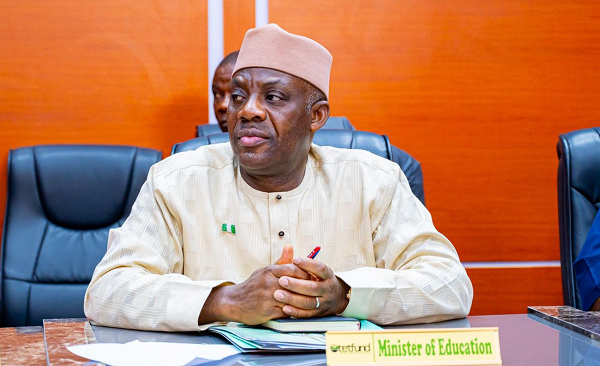
The Minister of Education, Dr. Tunji Alausa, has said the Federal Government’s ongoing reforms in the tertiary education sector are aimed at repositioning Nigeria as a knowledge-based economy anchored on research, innovation, and a predictable academic calendar.
Speaking on Channels Television’s Politics Today on Wednesday, Alausa noted that Nigeria’s large youth population can only become a true economic advantage if supported by quality education and a well-motivated academic workforce.
According to the minister, the government’s vision is to harness the creativity and potential of young Nigerians by providing an educational system that allows their talents to flourish. He explained that the recent agreement reached with the Academic Staff Union of Universities (ASUU) aligns with this broader objective, adding that years of prolonged strikes had previously weakened learning outcomes and stifled innovation.
Alausa revealed that since President Bola Ahmed Tinubu assumed office in May 2023, public universities have completed two academic sessions without industrial action, which he attributed to intentional and well-planned policy decisions.
He said the reforms include a 40 per cent increase in lecturers’ salaries, improved academic allowances, and the introduction of a new monthly “professor cadre allowance,” describing it as a landmark development in Nigeria’s university system.
The minister added that for the first time, a sitting president personally monitored negotiations with ASUU and declined to approve agreements without guaranteed funding. He stressed that funds were secured before approval, with implementation already underway.
Alausa also disclosed plans to establish a National Research Development Fund, through which the government intends to allocate at least one per cent of Nigeria’s Gross Domestic Product annually to research and innovation. He said this move is crucial to ensuring that research outcomes go beyond academic publications to deliver practical solutions, commercial ventures, and measurable national impact.
He further announced the inauguration of a Research, Innovation and Commercialisation Committee to strengthen collaboration between universities and industry, alongside new policies aimed at safeguarding intellectual property and promoting innovation.
Reaffirming the government’s commitment to industrial harmony, Alausa assured lecturers and other university workers that negotiations with non-academic staff are ongoing and that no group would be marginalised.
He emphasised that stability within tertiary institutions is a deliberate priority, noting that motivated lecturers, uninterrupted academic calendars, and sustained student engagement create an environment where research can thrive and national development can accelerate.
The minister added that recent investments in medical education, engineering, and technology workshops form part of a wider strategy to restore Nigerian universities’ capacity to deliver education that meets global standards.
According to him, the current administration is taking proactive steps to build a resilient system that supports teaching, research, and innovation as a means of securing Nigeria’s long-term future.